THE DONOR
From day one I have been very emotional anytime I think about the person’s heart I now have and their family. At first, I thought it was just the prednisone I was taking. But I am 2 years in and I still get misty. Early on that very first day post-transplant, I was celebrating my new gift and lease on life. My wife Lauren reminded me of something. There was a family that was planning a funeral and a wake at that very moment. They were probably in raw grief over the loss of their loved one. Hard emotions that will now be in the fabric of their lives for a long time to come. Every year on or around Feb 8th, I will celebrate an amazing life-giving milestone. At the same time, they will remember a terrible and most likely sudden loss.
One of the aspects to heart transplant that intrigues people is whether I know who the donor was. I know almost nothing about the donor or the donor’s family. I do wonder about the person whose heart I have. It is hard sometimes to think of it as really mine now. The fact that for the rest of my life I will swallow pills each day to stop organ rejection is a twice daily jab that the heart is not mine. Without the meds this heart does not biologically belong. I was even admitted to my medical center for 3 days for treatment because I was experiencing moderate heart rejection at 16 months post-transplant.
For me, there are a lot of aspects about my donor that have no bearing. It does not matter if this person was right, left or center politically. His religion or lack thereof is not disqualifying. His race or color is immaterial. Whether he was rich or poor has no bearing. What if my donor was an incarcerated criminal, or an undocumented alien? Does that matter? It’s hard to imagine any heart recipient thinking any of these make any difference.
This heart, most likley from a man vs a woman, is doing its job for me now every second of every day without any assistance. Roughly 36 million beats per year. About 700,000 gallons of blood. Every year. No assistance. No pacemaker. Just the heart.
WILL I MEET THE DONOR’S FAMILY?
I look forward to possibly meeting my heart donor’s family someday. If that day should arrive, I want to tell them how honored I am to be able to carry their loved one’s heart with me through the remainder of my life. That I consider it the highest obligation and privilege to care for and protect this life-giving gift from their loved one.
I hope they can feel comfortable enough to put their ear or a stethoscope to my chest and hear their loved one’s heart rhythmically pumping my lifeblood steady and sure, making my existence in this world possible. I am so grateful to be given this chance at extending my life that was heading toward an abrupt and unexpected end. The individual selfless decision to be an organ donor made that possible.
I like the word “Steward” to describe the role I have with this heart. Webster defines a Steward as “someone who takes great care and responsibility for that which has been entrusted”. The donor, the medical center and my Lord and Savior have now entrusted this heart to me. I intend to be a great steward.
THE PROCESS
The identifying information regarding organ donors and recipients is tightly controlled. If a transplant recipient would like to contact the donor’s family, the patient is instructed to write a short paragraph that will fit on a postcard size mailer. It should contain a short summary of the recipient without any identifying information. Additionally, it should include the motivation behind wanting to contact the donor’s family.
This short letter, given my location, is mailed to New England Donor Services (NEDS). Once received, NEDS will notify the donor family that there is a letter and ask whether they would like it forwarded on to them. If the answer is “No”, the process stops. If the answer is “Yes” then the letter is forwarded to the donor family.
Once the donor family receives the letter, they can notify NEDS if they would like to have ongoing contact with the recipient. If not, the process stops. If so, then identifying information is provided to both parties and NEDS steps aside so that the donor’s family and the recipient can communicate directly. The process is the same, in reverse, if the donor’s family first tries to reach out to the organ recipient.
THE LETTER
I sent my letter about 3-4 months post-transplant. I tried to research as much as possible about the appropriate amount of time to wait to send the letter. I wanted to send it earlier. I asked the social worker at the medical center and did some web queries about the appropriate timing, and she helped me with the letter content. My wife, who has a natural instinct and judgment in these things, provided appreciated input all around as well.
The letter was received by the donor family according to NEDS. That’s good! I feel at least my written sentiments are in hand with the donor family. Perhaps I jumped the gun and sent the letter too soon. I do have the option of sending another letter later. If I do that, it will be much later. Years later.
I have come to understand some of the reasons why a donor’s family may not want to have contact. Certainly, there are end of life situations that are too painful to be reminded of. Seeing me, meeting me, having a relationship of some kind with me and my family may be a constant reminder of the anguish of losing a loved one or the circumstances surrounding the loss. In addition, it’s possible the donor had multiple recipients of different organs. There could be several recipients of different organs contacting the donor family. That could be very overwhelming for them. I am sure there are other individual situations that could make contact prohibitive, painful, or unwanted. I understand, respect and embrace their decision.
As a participant in a couple of local heart transplant support groups I am active with, I have met many heart transplant recipients. I only know two people who have had heart transplants and met their donor families. In both of those cases it was a very meaningful and positive experience on both sides. Two is a very small sample. My very basic research reveals that the percentage of heart organ donors and organ recipients meeting is only about 3-5%. That surprised me.
CELLULAR MEMORY
Some people have asked me if I have noticed anything different about my behaviors or tastes, habits or fears due to having another person’s heart implanted. There are on-going discussions and theories about this aspect of transplant, particularly where it involves the heart. This idea is commonly referred to as “cellular memory”. The supposition goes that in some cases people noticed that organ recipients took on qualities or likes / dislikes attributed to their donor. Along with these discussions is technical and medical reasoning behind how or why this could happen.
I did some cursory reading on this. I may do more in the future. I tend to have an open mind on these kinds of questions. The only thing I can say is I don’t know. What I do know is that I have not noticed nor am I aware of anything like that happening to me. At the same time, I don’t think I agree with the opposite view that my new heart is just another muscle or just a pump that keeps me alive. It’s more than that. At least to me. Unlike many other organs, a heart only becomes available due to a death of another person.
TRANSMEDICS ORGAN CARE SYSTEM
If the heart came from a “heart in a box” device the patient has the option to decline the offer in that basis. This device is formally called the TransMedics Organ Care System. It is a new development approved by the FDA. The system keeps hearts viable longer than what the previous time constraint was, increasing the distance and time period a donor can be from the recipient.
It’s easy to forget that two different surgical teams are needed in what is likely two different locations for a heart transplant. The first surgical team removes the heart from the donor. I imagine this to be a solemn and sacred experience to be a part of a team removing organs from a patient who has recently died or being kept alive artificially purely for the ideal timing of organ removal. It must be nearly unimaginable in the case of a child. The second team implants the donated organ into the recipient.
“OPT IN” vs “OPT OUT”
The United States is a country where citizens need to “opt in” as organ donors. We must check the box when applying for a driver’s license or ID that we agree to be donors. For many other countries in the world, it is assumed you are an organ donor unless you “opt out.”
This is another politically discussed issue that some feel is in the category of “government intrusion”. The United States, more than other countries, positions itself as less accepting of government mandates. The thinking, by some, is that if you are required to “opt out” of being an organ donor and being an organ donor is assumed, then the government is overstepping.
Personally I don’t agree with that logic. No surprise there. If the system was “opt out” instead of “opt in” and you prefer not to be an ogan donor, then a person can make that selection. In addition, even in an “opt out” scenario the family is gnerally consulted Like so many issues, this is an education issue at its root. If it were presented in the right way, I think Americans would see “opt out” as a better system than “opt in”.
Logically this would increase the supply of organs available. If people were asked to consider that if a close friend needed an organ, or a son or daughter, or even themselves, would they not want a higher chance of survival in all those circumstances? Having more organs available does that. Even if that change only made a small difference, lives would be saved.
HONOR WALK
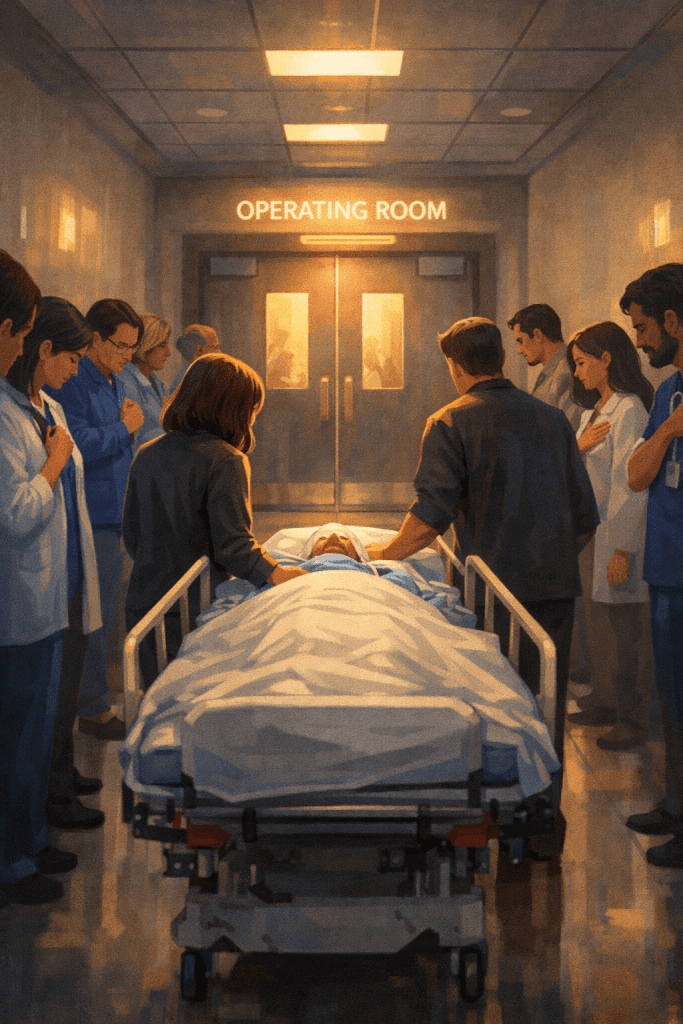
In some cases, an organ donor and their family join in an “honor walk”. Medical staff line a corridor from the ICU to the operating room. This happens while the donor is transported. It’s a quiet moment of respect, thoughtfulness, and deep appreciation.
MOMENTS
Lastly, Everyone has had a situation where someone else made it possible for them to experience something special. A wonderful moment. Or even just “a moment”. Perhaps someone asked you to go with them to a great concert or had tickets to a prized sporting event. How did that make you feel? Thankful? Overwhelmed? In debt?
A few months after my transplant, my son-in-law invited me to attend an NBA finals game where the Celtics won the championship! Wow! In another moment I was graced with watching one of my daughters becoming engaged to be married. I was so overjoyed to be there. My Mother-in-Law, who I am blessed to have in my life, turned 100 years old 2 months after my operation. Even though I was a little wobbly I was able to attend.
I had my transplant over 2 years ago as of this writing and have been able to attend several family events. Not only that, every day, every moment, every thought and action I have done during that time is because I was given a donated heart. Exuberance, sorrow, satisfaction, defeat – life. First and foremost, the donor made those moments, this moment, possible for me. It’s like that Christmas present you open and think “this is too much”. Do I really deserve all this?
If I live to the average 12 years post-transplant how many events, moments, actions and thoughts will there be that be that I owe to my donor? I try hard to stop during each day several times with a prayer of thankfulness for this amazing blessing. As time goes on, I fail with more frequency, but I try to pull myself back to a place of gratitude and away from that place of entitlement. With God’s help I will strive to be constantly vigilant and say prayers of thanks for my donor, to the medical team and to my loving wife and family for making my life longer than it would have been without them.
So for now I wait to hear back from my donor’s family. I pray for them that at some point the grief they have experienced heals for them to the point where we can meet. That perhaps meeting me and my family would help them as much as it would help me. I check our steel mailbox that stands like a sentry down the hill from our house everyday hoping there will be a response to the letter I sent to them asking for that opportunity. Maybe it’s there today.

 My Heart Transplant Journey
Leave a comment