
By Phil Liaboe
Coming Home
After 13 days I was finally going home with my donated heart. I was elated. 13 days is a short stay for a heart transplant patient. My stay was shorter than most because the disease that claimed my native heart allowed me to be ambulatory. Most patients who get the news that there is a match are already at the hospital and not walking. Some are in bed for weeks or months. Many of those patients have some type of artificial assistance helping with heart function. Relatively speaking I was in better shape going in than most who get this operation, therefore my recovery was faster.
I was wheeled down to the lobby at about 7 PM with my bags and all the meds on my lap. More bags were hanging by their handles from the grips on the back of the wheelchair containing my clothes and electronics. Lauren brought our car around as I was pushed through the large automatic doors into the swirling frigid February winds that seem to never stop in cities with surrounding high-rise buildings. Lauren loaded the bags into the back of our hatchback and carefully folded my tall frame into the backseat. Heart transplant patients are not allowed to ride in the front seat for about a month.
As WAZE directed us through the best route to our home, I had my back against the driver-side back door. We took Storrow Drive eastbound into the city center to join up with I93 North. Storrow Drive is a busy 2 lane roadway that runs along Boston’s Charles River on one side. On the other side there is a view of the backside of the tony brownstones on Beacon Street in the Back Bay section of the city. From my sideways perch looking at the back of those residences through the dead of winter, I could see soft amber lights and chandeliers. It oozed warmth, comfort and people cooking which made me want to be home with Lauren more than ever.
MONITORING
One of the biggest differences between a heart transplant and other hospitalizations is that once a transplant patient arrives home, important patient monitoring and treatment continues. Only now, the patient and caregiver are performing those duties. In addition to medications, we were instructed to keep a log and record several data points regarding my basic health several times per day.
Blood glucose was tested and recorded at home using a small needle kit 3 times per day. This kit was provided by the medical center, with very in-depth instructions. Glucose was tested before breakfast, before lunch and before dinner. I swabbed my finger with alcohol, pricked my finger with a small spring-loaded lancet and then carefully touched a test strip to the small blood drop. The test strip was connected to a handheld reader that would display and announce the sugar level. If the level was over a certain threshold, I needed an insulin injection. The insulin injection only happened a handful of times for me. I was also taking Metformin, a medication to lower blood sugar. We kept records of each reading.
I also was to take and record my blood pressure using a BP cuff the hospital provided. Temperature and weight were also tracked and recorded. And of course, assuming all responsibility for all the medications was the biggest and most complex part of the transition home. Some of these activities go on for months.
WALKING
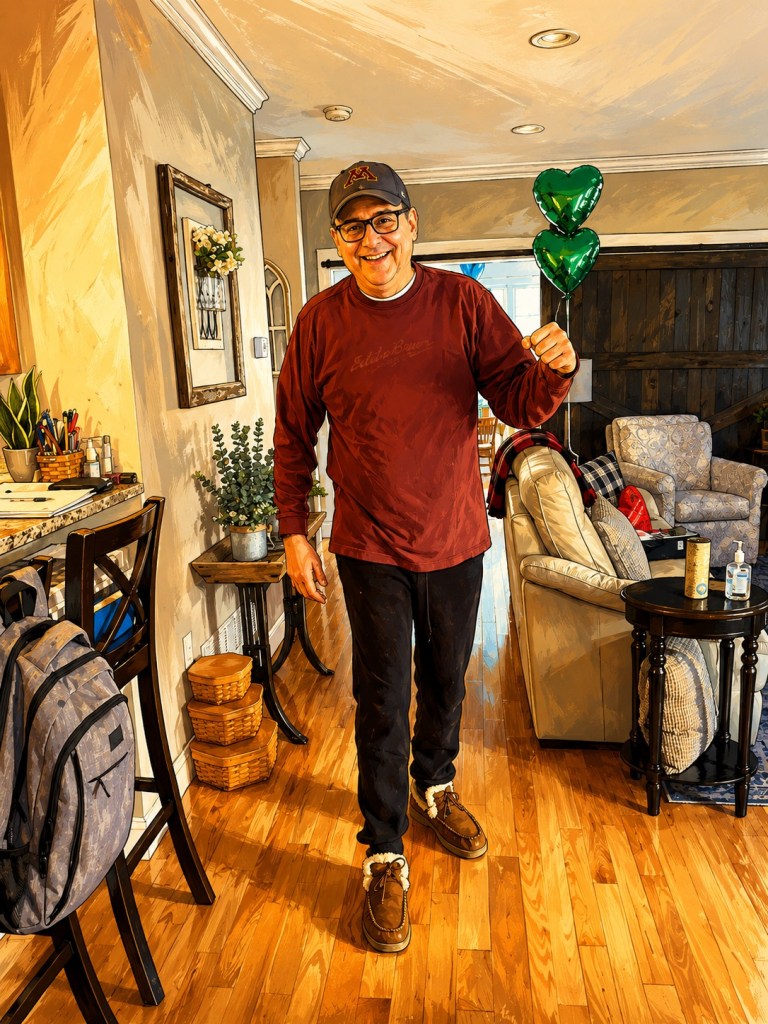
From the first day I arrived home I resumed the walking discipline I had been working on in the corridors of Beth Israel Deaconess. There is an open straightaway path in our home of about 85 feet (34 steps). It starts at the far end near our back deck and double slider and cuts through the living room, dining room, goes past the kitchen, right by the front door and into our guest bedroom. I kept a tally of how many steps I did each time I walked, and I timed it. My goal was to walk faster and to increase my steps each day. I wanted to push myself a little bit each day but was warned not to overdo it. I walked more than once a day like this. My confidence walking increased steadily.
After about 4 or 5 days I was ready to walk outside. That was a big day. I was most afraid of tripping on something and falling. I was hyper afraid of doing anything that would disturb the still tender and stitched together rib cage and chest. Lauren held my hand as I very slowly walked out the door, down the short driveway and turned left. We slowly walked about 2 or 3 houses down the street and then came back. There was a pronounced difference between taking steps on smooth and perfect man-made floors compared to navigating and carefully planning foot placement on the street. I was on my way.
TRANSPORTATION
There was a significant time period of time before I was able and allowed to drive. Heart transplant patients are not allowed to sit in the front seat of a car for about a month. After that, the patient can graduate to sitting in the front seat assuming the healing is going as planned. At about 4 months, I was allowed to drive. My license had been shelved due to defibrillations I had experienced before the transplant. Because I had a new heart and the defibrillator had been removed, I was able to get my driver’s license reinstated.
The time frames listed above can vary somewhat depending on the medical team and how the patient is coming along. Another factor that can determine when a patient can drive is their caregiver. My caregiver is my wife, Lauren. If my doctors said I could move to the front seat in 4 to 6 weeks, Lauren somehow heard 6 to 8 weeks. If they said I could drive in 3 to 4 months, Lauren heard them say 4 to 5 months which in her world should really be 5 to 6 months to play it safe. Are you following this? I honestly do not recall how long it was before I could drive but it took some convincing get those privileges back.
To those who are thinking I should declare my rights and confront my wife and caregiver about perceived over-protection, I want to add this thought. Everything that has happened to me has affected her. The sacrifice in time she has made for me has been tremendous. The plans for our future were veered off course because of my health. Nobody wants to be cared for, and I don’t believe many people like their circumstances inflicting hardship on others. But that is what I did when I got sick. And I did it to the person who I love the most. I want to avoid any more of that difficulty anywhere I can. What happens to me affects her. Plus, she is smarter and has a better instinct about many things and I respect that.
I do recall taking the car the first time. I had not driven a car in over 3 years. Lauren was standing in the garage opening, waving at me as I was pulling out backwards into our street. At 65 years old I felt exactly like a 16-year-old just getting my license. The song that has always brought back to that feeling of my teen years driving was Elton John’s Philadelphia Freedom. Just typing those words right now sends a strong sensation of driving around my hometown in Edina Minnesota, arm and elbow resting on the open space left by the lowered window in my Dad’s hunter green V8 engine equipped Buick Skylark.
When I resumed driving, there was a distinct feeling that cars around me were moving fast. It took some adjusting to get used to the speed the world was operating at. I was comfortable at 55 mph on the highway. Not so much at 70 mph.
CLINICS
The transplant team kept a close watch on me. We would truck into Boston pretty frequently at first and then less frequently as time went on. These visits were for Clinics. In the clinic, the nurse practitioner (NP) would do a complete review of where everything stood. The NP would see how I was feeling, check vitals, look at the status of the incisions, review the meds, and see if there was any fluid buildup by looking at my neck veins as well as my legs. I was scheduled to come in once per month for the first 3 months. Then it backed off to once every 2-3 months and so on. Generally, these clinics were timed to correspond with some other test they required. Tests that were combined with the visit for a clinic included heart biopsies, cardiac echo tests, and chest x-rays. For me because of some unusual circumstances, I also needed PET scans, MRIs and a left heart catheterization. I will get into why later.
These visits were helpful and reassuring to us. We felt like the medical team was watching me closely. I always brought a notebook with a list of questions that Lauren and I would prepare beforehand. We also brought our daily recorded data we were tracking at home (glucose, weight, temperature, blood pressure). If we thought of something between visits, we would just add it to the list if it was not urgent. In each visit the NP would clearly outline the upcoming schedule of events – biopsies, CareDx, procedures and the when the next clinic was scheduled.
HELP NEEDED
I could not shower alone for several days. Wet tile is naturally more slick than a dry surface and I was constantly afraid of falling. Those first few days I just tried to steady myself inside the shower while Lauren did the washing. There are just too many unforgiving hard surfaces and corners in there to even take a chance on a tumble.
I needed help dressing. Yes, at 65 I had come full circle. I needed someone to help me with my underwear. Embarrassing but true. I was using compression socks (I still am) and pulling those on takes some force. Recall I am still not supposed to use my hands or arms to push, pull or lift anything. Lauren had to put my socks on for a while.
From a cognitive standpoint I was not able to do the normal tasks I had around the house for a few weeks. I stayed away from our finances. Looking back, I am a little surprised Lauren didn’t change our IRA password during this time. Of course it also follows that filling the medication box, taking my blood glucose, and the detailed process for injections of correct insulin injections were way beyond my brain function for that time. I’d guess it was about a month before I got a grip on things.
I was so grateful that Lauren was there to help me.
RED CELL COUNT
I was cold when I first got home and stayed that way for weeks. My red blood cell count was significantly under normal on blood tests and it took a long time for that number to creep up back into the normal range. Until that time it was hard for me to stay warm.
TV
It’s amazing watching TV now. Any medical show we watch I hear terms and procedures that I have great familiarity with. Ventricular tachycardia, defibrillation, ICD, heart catheterization, various medications are all part of my vocabulary now. It’s incredible how many times these things get mentioned in various TV shows. And of course, it seems like every show we watch now has some kind of reference to a heart transplant or even that rare disease cardiac sarcoidosis that wrecked my native heart.
VIDEO PROJECT
3 weeks after my transplant (I had only been home a about a week) the medical center asked if I would be interested in working on a video for them encouraging philanthropy. In addition to checking my interest, they wanted to make sure it was not too much activity after all I been through. I agreed to help and felt like it was the least I could do after all that had been done for me. Plus, it was nice to feel a little useful to someone.
It was timed to be on the same day as one of my early heart biopsies routinely checking for organ rejection. Lauren and I got there early and settled into the spacious and quiet top floor lobby while the filming crew set up. The kind young woman who set this up asked me questions and my answers were videotaped. An edited version was put on the medical center web site along with an article about the new transplant capabilities made possible by the Klarman Foundation. I recall being very shaky throughout the entire process. At that time, I was still in a mode where I was concentrating to take one step at a time just to walk a few feet. The web page and video are at this link:
https://giving.bilh.org/bethisraeldeaconessmedicalcenter/philanthropy-news/a-new-lease-on-life/
GETTING ACLIMATED
Days, weeks, months went by and I got stronger. I was walking outside more. I had a handle on my health data recording and managing my medications spreadsheet. For the first 6 months we stayed pretty clear of any crowds or people. If I was in a crowd I wore a mask and I used anti-bacterial hand cleaner whenever I thought to use it or when Lauren reminded me.
I played my first round of golf on Friday June 28th. I had done a little tester at a driving range a few days before and had clearance from the transplant team to go ahead. They added that I should be really careful and to stop if I felt any incision pain in my sternum. I played 9 holes. I rode in a cart. I felt good. I played as a single and was joined with 2 women golfers at the first tee. One of the ladies was a nurse at Tufts Medical Center in the electrophysiology department and she remembered me. She was amazed I was out swinging a club 4 months after transplant.
My biggest foray into the public was a Boston Celtics game at the TD Garden. It so happens it was game 5 of the NBA Finals on June 17, 2024, against the Dallas Mavericks. My terrific son-in-law had invited me to this game, and I convinced Lauren that I would take all necessary precautions.
The Celtics were up 3 games to 1 in the series and had an excellent chance of winning it all that night. I masked up, kept my hands in my pockets and went to the game and the Celtics won! I had never been to a championship game like that ever before. It was amazing. One in a long list of moments made possible by people surrounding me with love, medical care, the angel who donated his heart. All of it enabled by God’s amazing grace.
Coming on the next post is a topic near and dear to everyone. Food! Another important topic for long term success and some surprising and counter intuitive changes to my diet.
© 2026 Phil Liaboe. All rights reserved.


Leave a Reply